Giant and Bohemian knotweed
At SE Knotweed, we identify giant knotweed (Reynoutria sachalinensis) by its far larger heart-based leaves up to 40 centimetres, and the Bohemian hybrid (Reynoutria x bohemica) that sits between it and Japanese knotweed. Treatment and the guarantee are much the same across all three.
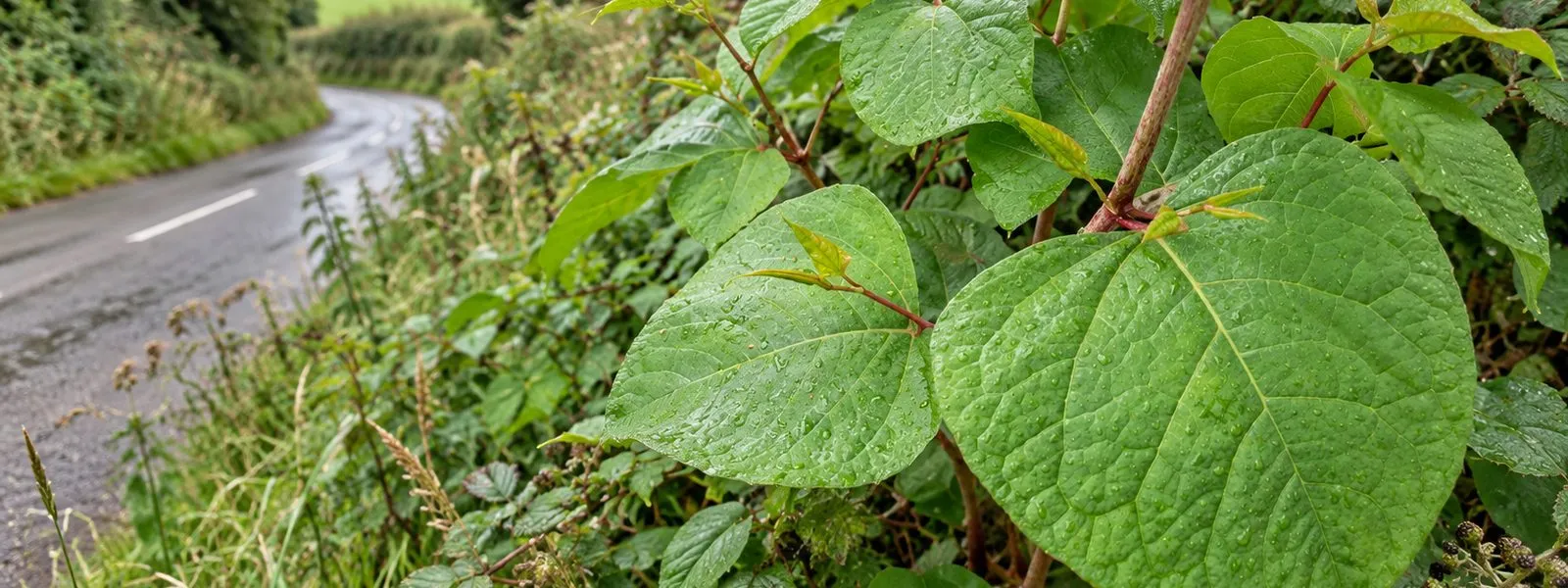
What is giant knotweed?
Giant knotweed, Reynoutria sachalinensis, is a larger relative of Japanese knotweed, reaching 4 metres or more with hollow canes and heart-based leaves up to 40 centimetres long, far bigger than the shovel leaf of Japanese knotweed.
It is less common in the UK than Japanese knotweed but turns up on larger and rural sites, and it is treated with the same methods and covered by the same guarantee.
What is Bohemian knotweed?
Bohemian knotweed, Reynoutria x bohemica, is the hybrid of Japanese and giant knotweed, and it sits between the two in leaf size and shape. It can be more vigorous than either parent and sets viable seed more readily, so it spreads by both rhizome and seed.
Because the hybrid is easy to mistake for its parents, a specialist confirms the species at survey where it matters for a sale or a claim.
How do I tell the three apart?
Leaf size and base are the quickest guide: Japanese knotweed has a shovel leaf with a flat, straight base up to 14 centimetres, giant knotweed a large leaf with a deep heart-shaped base up to 40 centimetres, and the Bohemian hybrid a leaf in between with a shallow heart base.
All three share the hollow speckled cane and the creamy late-summer flowers, so the leaf is the tell. Our identification guide covers the shared signs.
Does the treatment or guarantee differ?
The treatment does not differ in any material way. Giant and Bohemian knotweed respond to the same herbicide programme, excavation and containment methods as Japanese knotweed, and the work carries the same insurance-backed guarantee a lender accepts.
The main practical difference is scale, since a giant knotweed stand is larger, so the survey confirms the species and sizes the job accordingly.
Common questions
- Is giant knotweed worse than Japanese knotweed?
- It grows taller and has much larger leaves, but it is treated and guaranteed in the same way. The Bohemian hybrid can be more vigorous, which is one reason a specialist confirms the species at survey.
- Does the type change the treatment?
- Not materially. The same herbicide, excavation and containment methods apply, and the same insurance-backed guarantee. The survey records which species is present.
Book a survey and get a costed plan
Tell us the address and what a surveyor flagged. We confirm the plant, record the RICS category and set out the figures.