How to identify Japanese knotweed
At SE Knotweed, you identify Japanese knotweed by its hollow bamboo-like canes flecked green and red, its shovel-shaped leaves set in a zig-zag along the stem, and its sprays of creamy-white flowers in late summer. Send us a photograph and we will confirm it.
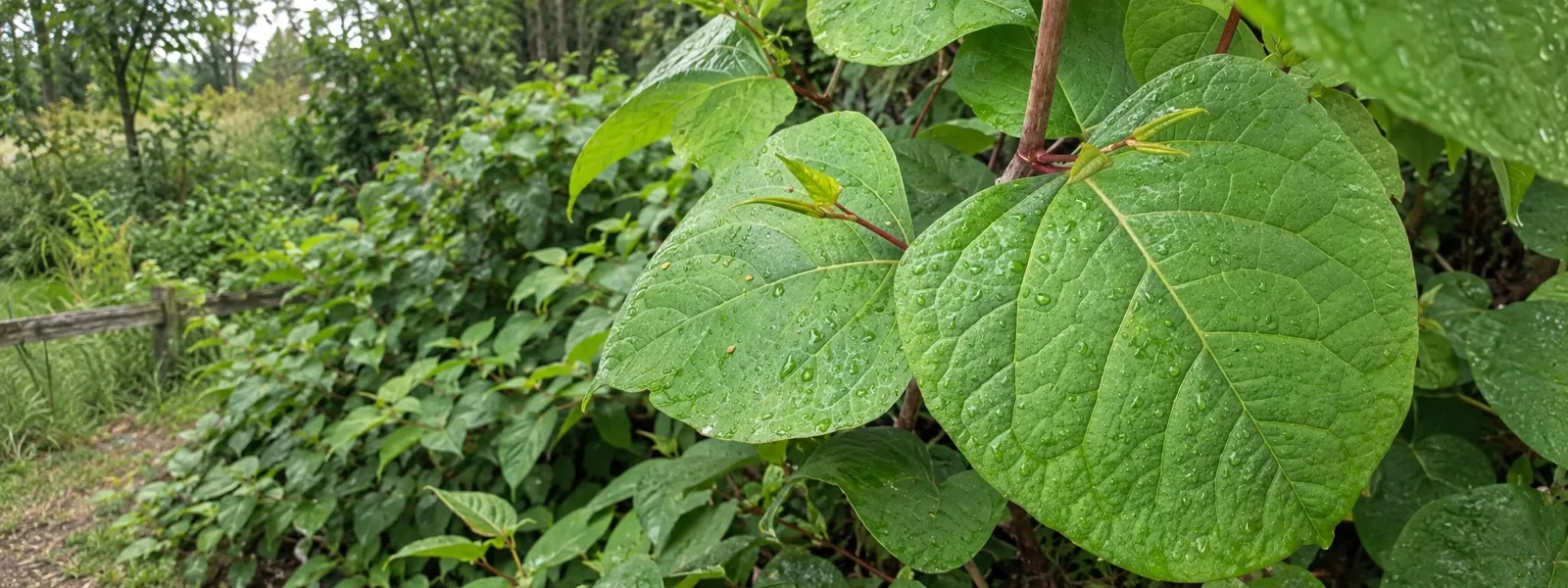
What does Japanese knotweed look like?
Japanese knotweed has hollow, bamboo-like canes that are green with red or purple speckles and grow to 2 to 3 metres in a single season. The leaves are bright green, shaped like a shovel or shield with a flat base and a pointed tip, up to 14 centimetres long, and they alternate along the stem in a clear zig-zag.
From late summer it carries sprays of small creamy-white flowers. If what you are looking at matches this, book a survey and we will confirm and map it.
What do the spring shoots look like?
In spring, knotweed pushes up pink or red shoots that look a little like asparagus spears, unrolling into the familiar green canes and shovel leaves as they grow. This is the fastest growth of the year, with a stand reaching full height by early summer.
The spring shoots are a useful early sign, because they appear before most of the plants knotweed is confused with, and catching a stand early makes treatment or removal simpler.
How do I tell it apart from similar plants?
Several garden plants are mistaken for knotweed, and the tells that separate them are the hollow speckled cane, the staggered zig-zag leaf pattern and the flat-based shovel leaf. Bindweed climbs and twines, Russian vine has similar flowers but a woody climbing habit, and bamboo has round woody canes with narrow leaves.
Our look-alikes page sets each one against knotweed, and if the plant is a different invasive species, our sister site Weed Warden covers it.
What does it look like through the year?
Knotweed changes markedly across the seasons, so the time of year shapes what you are looking at: red shoots in spring, dense green growth and creamy flowers through summer, yellowing leaves in autumn, and hollow brown canes standing through winter.
Because a dormant winter stand looks nothing like its summer self, our seasonal identification page shows each stage so you can recognise it whenever you find it.
Can you confirm it from a photograph?
In most cases we can tell from a clear photograph of the stems and leaves, ideally with something for scale, and we will say honestly if we cannot be certain without seeing it.
Where a sale, a mortgage or a neighbour dispute turns on the answer, a site survey gives a documented confirmation and a measured record a lender or solicitor can rely on. Send us a photo to start.
Common questions
- How can I tell Japanese knotweed from a look-alike?
- The zig-zag stem, the shovel-shaped leaves in a staggered pattern, and the creamy August flowers are the clearest signs. Bindweed, Russian vine and bamboo are the usual confusions. A photograph or a survey settles it.
- What does knotweed look like in winter?
- It dies back to hollow brown canes that stay standing through winter. The dead canes are still a reliable sign the plant is present.
- Do I need a survey to be sure?
- For a sale, a mortgage or a neighbour dispute, a survey gives a documented confirmation a lender or solicitor can rely on. For your own reassurance, a clear photograph is often enough for us to say.
Book a survey and get a costed plan
Tell us the address and what a surveyor flagged. We confirm the plant, record the RICS category and set out the figures.